
How Much Did You Pay for Your Outdoor Kitchen? The Patio Kitchen Cost Guide
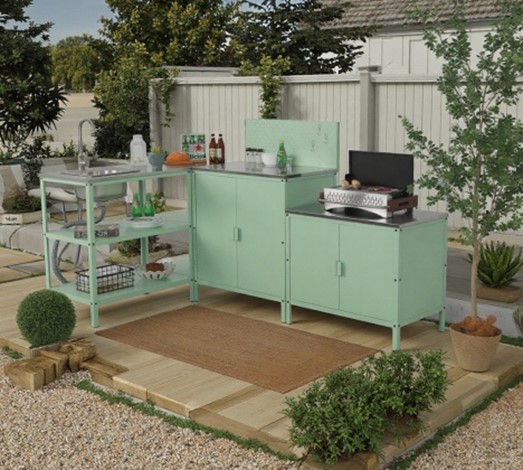
Ask ten different buyers how much they spent on their outdoor kitchen, and you’ll get ten completely different figures. The term “patio kitchen” covers an extremely broad spectrum of products: it could be a compact unit with just a grill and storage cabinets, mass-produced modular outdoor kitchen sets for retail sales, or a fully finished luxury terrace space complete with plumbing, outdoor refrigeration, integrated lighting, shade structures and custom countertops.
For distributors, importers, outdoor-living retailers, hotels, restaurants, and project buyers, the better question is not only “how much did you pay?” It is “what cost structure gives the right appearance, weather resistance, installation speed, and margin?” This guide explains the main outdoor kitchen cost drivers and how to evaluate a patio kitchen before requesting a quote.
Quick answer: what should buyers expect to pay?
From a residential consumer benchmark, industry platform HomeAdvisor’s official outdoor kitchen cost survey puts the national average installed price at $16,587, with most finished residential projects falling between $6,304 and $27,087. Minimal compact grill stations will land below this bracket, while high-end fully custom builds featuring masonry foundations, full utility routing, overhead roofing, built-in refrigeration and premium brand appliances easily exceed the upper end of this range.
For B2B sourcing, treat those numbers as a market signal rather than a quotation. A supplier quote usually separates the product system from project extras: cabinets or frame, grill and appliances, sink and worktop, packaging, container loading, freight, installation, channel margin, and after-sales support.
|
Buying scenario |
Typical spend signal |
What usually changes the quote |
|
Compact grill and prep station |
Often below a full installed kitchen budget |
Module count, grill size, storage, packaging, and whether utilities are needed. |
|
Standard patio kitchen for retail or residential projects |
Often aligns with the common installed outdoor kitchen range |
Cabinets, countertop, sink, grill, site labor, freight, and local code requirements. |
|
Modular outdoor kitchen program |
Can be quoted as repeatable SKUs plus freight and margin |
Container loading, color customization, carton type, spare parts, and warranty plan. |
|
Custom built-in hospitality or premium residential project |
Can move well above the average consumer range |
Masonry, plumbing, electrical work, shade structures, refrigeration, and high-end appliances. |
Why the patio kitchen price varies so widely
Outdoor kitchens shouldn’t be treated as one-off single products—they’re integrated assemblies assembled from dozens of distinct parts. A common misstep many buyers run into is drawing unfair cross-category comparisons: matching mass-produced modular prefab units against fully bespoke masonry outdoor builds, or bare cabinet frames against complete, ready-to-install patio kitchen showroom sets. Every product tier comes with its own baseline cost and distinct selling value for retail distribution.
- Overall layout size & number of functional modules: If you only need a simple single grill unit with basic enclosed storage, the cost will stay pretty low. But once you expand into a longer multi-section setup with dedicated food prep zones, an integrated sink, open shelving, full cabinet doors, side serving tables and matching add-on accessories, your total expenditure climbs noticeably.
- Cabinet and frame material: Standard indoor cabinets won’t cut it outdoors. Any outdoor kitchen cabinet has to come with tough, long-lasting surface treatments, built-in drainage channels to flush away rainwater, full anti-corrosion treatment, and heavy-duty hinges, latches and fittings engineered to stand up to constant outdoor exposure year-round.
- Full suite of built-in appliances: Every extra piece of integrated equipment shifts the overall project budget up: main built-in grills, secondary side burners, outdoor refrigerators, ice bins, integrated sinks and ambient lighting all add manufacturing costs. They also raise the bar for your post-delivery service work, as customers will expect consistent support for all these built-in components down the line.
- On-site utility installation work: Most factory product quotes only cover the physical kitchen unit itself, leaving all utility work unpriced. Running water plumbing, gas supply lines, waste drainage systems and outdoor electrical wiring doesn’t show up on the initial product invoice, yet these labor and material costs drastically inflate the final total your end customer has to pay.
- Supply chain logistics and retail profit markups: For B2B buyers sourcing these units in bulk, there’s a whole list of hidden costs you can’t overlook. This includes heavy-duty export packaging, reinforced carton wrapping to avoid transit damage, container loading and stacking fees, spare replacement component stock, warehouse storage fees, last-mile delivery charges, plus the standard profit markup required for every retail and distribution channel along your sales pipeline.
Modular, prefab, or custom: which route controls cost best?
A custom build can look impressive, but it is difficult to standardize across stores, project sites, and online catalogs. A modular outdoor kitchen or prefab outdoor kitchen is easier to quote, repeat, photograph, ship, and train sales teams around. That repeatability is especially valuable when the goal is to build a product line rather than complete one private backyard.
Custom outdoor kitchen cabinets still matter when a project has an unusual footprint, a luxury brief, or strict architectural requirements. But for many B2B programs, modularity reduces the number of decisions between first inquiry and confirmed order. The buyer can compare module dimensions, material, finish, appliance compatibility, carton data, and container loading instead of rebuilding the quote from zero.
What to include in a serious patio kitchen quote
When a buyer asks what someone paid for the patio kitchen, the answer should be itemized. A low headline price can become expensive if it excludes the parts that make the product sellable, shippable, or supportable.
- Product scope: frame, doors, shelves, countertop, sink, grill zone, fixtures, and accessories.
- Material and finish: steel, stainless steel, aluminum, powder coating, hardware, and corrosion protection.
- Packaging: carton type, export protection, assembly instructions, spare hardware, and image labels.
- Commercial terms: MOQ, lead time, container loading, sample terms, payment terms, and warranty handling.
- Market fit: target retail price, expected margin, installation complexity, and whether the product supports repeat orders.
Mistakes that make the final price look wrong
Many outdoor kitchen budgets fail because the first quote and the final installed cost are not measuring the same thing. One supplier may quote only the cabinet body, while another includes the sink station, grill support, packaging, and accessories. One retailer may compare outdoor kitchen cabinets alone, while another compares a complete patio kitchen display that is ready for product photography and showroom sales.
- Do not compare unit price without scope: ask exactly which modules, fixtures, shelves, panels, hardware, and accessories are included.
- Do not ignore replacement parts: doors, handles, shelves, fasteners, and finish touch-up support affect after-sales cost.
- Do not leave packaging until the end: a good outdoor patio kitchen needs export protection that matches the product weight and finish.
- Do not over-customize the first order: prove demand with a clean core model, then add private-label or project-specific options once volume is clearer.
Where JoyeLeisure fits
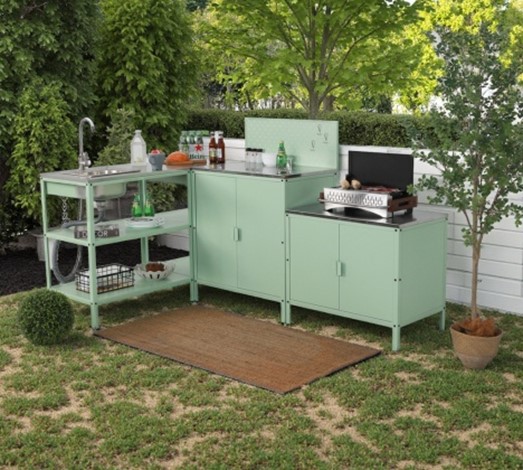
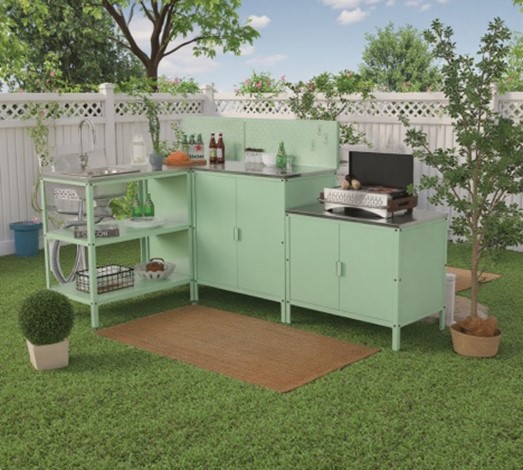
JoyeLeisure is positioned around outdoor living products for B2B buyers, and its Mesola Steel Outdoor Kitchen Set is useful for a cost-focused article because it packages several outdoor kitchen functions into one repeatable layout. The product page lists a steel structure with outdoor powder coating, an integrated countertop, cabinets, shelves, and sink. It also lists B2B planning details such as customization options for color and carton type, lead time, MOQ, and production capacity.
That type of product helps a buyer move from a vague outdoor kitchen idea to a defined patio kitchen SKU. Instead of comparing only outdoor kitchen prices, buyers can evaluate the cabinet layout, finish, storage, sink station, grill position, image quality, packaging, and quote terms as one commercial package.
How to keep an outdoor kitchen on a budget without cheapening the offer
An outdoor kitchen on a budget should not mean weak materials or confusing specifications. For B2B buyers, the stronger approach is to control the configuration. Choose a clean base model, keep the module count focused, standardize finishes, and make optional accessories easy to upsell.
- Use one or two hero configurations instead of too many near-identical SKUs.
- Keep the grill, sink, and storage relationship simple so product photos and installation are clear.
- Choose finishes that photograph well and fit multiple patio furniture collections.
- Make carton size, assembly steps, spare parts, and replacement panels part of the sourcing conversation.
- Reserve full customization for confirmed project volume or private-label programs.
A simple B2B cost formula
Before comparing suppliers, use this formula: product system + appliance package + packaging + freight + installation readiness + margin + service reserve. This keeps the conversation practical. It also prevents a buyer from choosing the lowest unit price and then discovering that packaging, parts, images, instructions, or after-sales support were not strong enough.
If the target customer is a homeowner, the final installed price matters. If the customer is a retailer, hotel group, distributor, or garden center, the repeatability of the quote matters just as much. The best patio kitchen program is one the sales team can explain quickly, the warehouse can handle safely, and the end customer can picture in a real outdoor space.
Final recommendation
So, how much did you pay for your outdoor kitchen? The most useful answer is a range with a reason. A full installed project commonly sits in the low-to-mid five figures, while compact or modular product systems may be planned differently depending on quantity, accessories, and freight. For a B2B buyer, the winning patio kitchen is not simply the cheapest. It is the one with the clearest configuration, strongest outdoor materials, cleanest quote structure, and best fit for repeat sales.
If you are building an outdoor kitchen line, comparing prefab outdoor kitchen options, or preparing a project quotation, request a patio kitchen quote from JoyeLeisure with your target market, quantity, preferred finish, packaging needs, and appliance requirements.
FAQ
- What is the average cost of an outdoor kitchen?
HomeAdvisor reports an average outdoor kitchen cost of $16,587 and a typical range of $6,304 to $27,087. The final price depends on size, cabinets, appliances, utilities, worktops, labor, and whether the buyer chooses a modular or custom build.
- 2. Which specifications matter most for outdoor kitchen cabinets?
Material, coating, hardware, drainage, corrosion resistance, door fit, worktop durability, and replacement parts all matter. For B2B buyers, carton protection and assembly clarity are also important because they affect damage rates and customer support.
- How can buyers keep a patio kitchen on a budget?
Start with a focused base configuration, standardize finishes, avoid unnecessary appliances, and separate optional accessories from the core SKU. Do not remove the weatherproof features that make the product safe for outdoor use.