
When Is the Best Time to Buy Patio Furniture?
The best time to buy Patio Furniture depends on the job the order must do. A retailer replenishing a current range, an importer building next season’s assortment, and a buyer developing a private-label collection need different purchase windows. Available stock can suit a late-season order. A new collection needs earlier specification work. A custom program needs enough time for samples, packaging approval, and destination-market documents.
For global B2B buyers, the useful question is “When can this order arrive with the right products, packaging, documents, and selling window?” Start with your target launch date, then work backward through product selection, sample approval, production planning, inspection, and shipping arrangements.
Choose Your Patio Furniture Buying Window by Goal
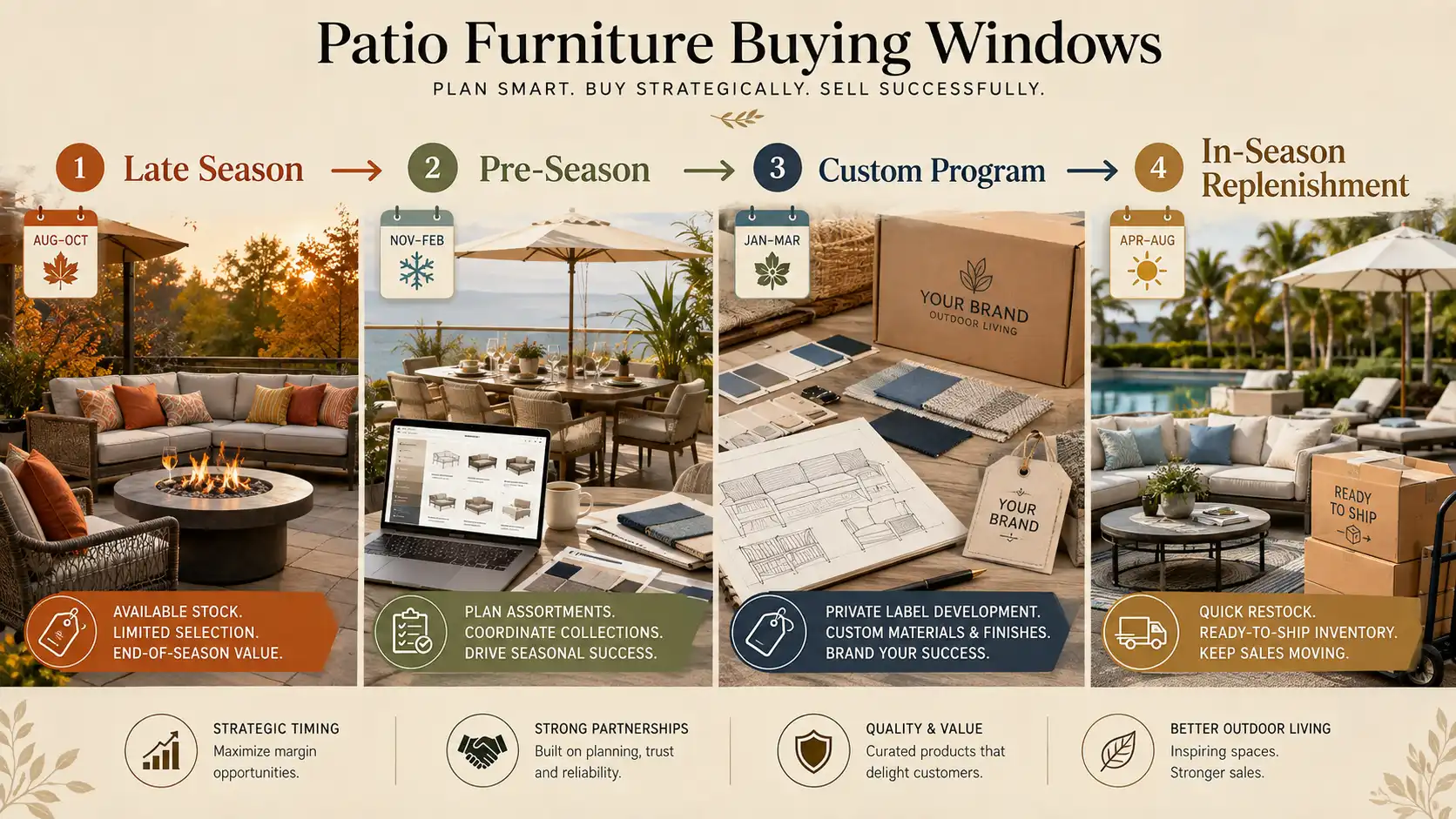
Patio Furniture buying has four common goals. Each one changes the balance between price, selection, speed, and specification control.
| Buying Goal | Planning Window | Main Decision | Trade-Off to Manage |
|---|---|---|---|
| Available-stock value | Late season | Select confirmed remaining inventory | Fewer colors, configurations, or matching accessories |
| Full range selection | Before peak outdoor demand | Approve the assortment while more choices are open | A longer planning cycle and earlier budget commitment |
| Custom or private-label program | Off-season and pre-season | Lock specifications, samples, packaging, and documents | Forecast accuracy and approval discipline |
| Immediate replenishment | In season | Prioritize ready-to-ship stock and approved substitutes | Tighter choice and delivery options |
Late-season buying can work well when you can accept a defined stock list. Ask for the exact item list, quantities, colors, condition, packing method, and replacement availability before you commit. A patio set with no matching chair, cover, cushion, or spare part can create a gap in a retail display or online listing.
Early planning works when range consistency matters more than a short-term promotion. It gives your team time to compare seating, dining, shade, storage, and accessory categories as one selling program. It also gives space to confirm which products can share finishes, fabrics, cartons, and product-page assets.
When to Buy Patio Furniture for Range Selection
For a new selling season, start with the market you will serve. A garden center, a hospitality project, an online store, and a furniture chain use different product mixes. The buying window should support the end use, the target climate, the sales calendar, and the inventory model.
Plan New Collections Before Seasonal Demand Builds
Use the earlier stage of planning to build a clear assortment. Define the main seating formats, dining sets, lounge pieces, sunshade products, and accessories before requesting a final quotation. This step matters when colors, cushions, frame finishes, and complementary products must work together.
Joye Leisure lists outdoor seating, tables, PE wicker products, open-frame furniture, sunshade products, outdoor kitchens, storage, and camping items in its outdoor furniture range. That breadth can support a coordinated outdoor-living program. Your buying brief still needs a focused product list. A broad catalog does not replace a category plan.
Ask the supplier for the data that matters to your sales channel: available product dimensions, carton dimensions, assembly method, load information where applicable, care instructions, image assets, and the documents required by the destination market. Each figure should identify the product model and test or usage condition.
Use Late-Season Buying for Confirmed Stock Needs
Late-season orders suit a buyer who has a defined need and can select from confirmed stock. They can help fill a sales gap, support a warm-climate program, or prepare a limited launch for the following season. The order must be checked at SKU level.
Request a stock list that shows the product code, material, finish, color, quantity, carton count, and any available accessories. Confirm whether the stock uses the same specification as your existing range. If it does not, decide whether the item will sit under a separate product page, a clearance label, or a distinct collection name.
When to Buy Patio Furniture for Custom and Private-Label Programs
Customization works best as a planning process that begins before a target selling season. Product development, sample review, packaging, and approval of the selling assets need an agreed sequence. A late request can leave less time for design decisions and shipping preparation.
Confirm Specifications, Materials, and Packaging Early
Start with the product construction. Joye Leisure’s knowledge base names PE and HDPE rattan, aluminum alloy, stainless steel, hardwood, outdoor fabrics such as solution-dyed acrylic, and quick-drying outdoor foam. Each selected SKU needs its own material specification. A category name alone does not define the frame, weave, fabric, finish, or cushion construction.
KD construction and packaging affect more than container use. They shape assembly time, damage risk, instruction design, spare-parts planning, and e-commerce handling. Joye Leisure describes packaging support and KD construction for freight planning. Your RFQ should state the intended sales channel, carton limit, labeling requirements, assembly expectations, and any marketplace packaging rules.
For a private-label program, add the brand artwork, logo position, color standard, product label, instruction language, and required photography to the approval list. Keep each approval tied to a revision number. This record helps the buyer, supplier, and inspection team work from the same specification.
Build the RFQ Around Your Target Launch Date
An RFQ should explain the commercial job of the order. Include product categories, target quantity, destination, target sales season, and required delivery window. Add the trade term you need, the packing format, the inspection points, and the documents your market requires.
Joye Leisure states that it supports OEM and ODM projects. Its material also describes finished-product appearance and function inspection, process monitoring, and managed technical documentation. Ask which of those steps apply to the selected product, then include them in the purchase specification. Treat certificate names, warranty terms, performance data, and market-compliance claims as product-specific items that require current evidence.
Match Patio Furniture Materials to the Sales Market
Material selection should follow the product’s expected use. A poolside set, a café terrace chair, a rooftop dining table, and a garden storage unit face different conditions. Buyers should define sunlight, moisture, salt exposure, cleaning expectations, traffic level, and storage conditions before they finalize a range.
PE Wicker and Open-Frame Ranges
PE wicker collections and open-frame furniture support different visual and operational needs. For either range, request the frame material, weave or rope specification, surface finish, fabric information, care guidance, and spare-parts policy for the exact SKU. Those details are more useful than a general claim about outdoor durability.
Use a sample review to check the points your end customer will notice: seating comfort, join quality, finish consistency, assembly instructions, carton condition, and the appearance of any matching table or cushion. For online sales, photograph the product in the same configuration that will be delivered. For retail displays, verify the accessory and color combinations before the range is listed.
Outdoor Kitchens, Sunshade Products, and Accessories
Outdoor kitchens, grills, canopies, storage products, cushions, and bases each need a separate specification review. Ask for installation needs, maintenance instructions, accessory lists, and model-specific documentation. Wind, heat, load, fire performance, and certification claims must match the exact product and market. Do not carry a claim from one item into another product family.
A Patio Furniture Purchase Checklist for Global Buyers
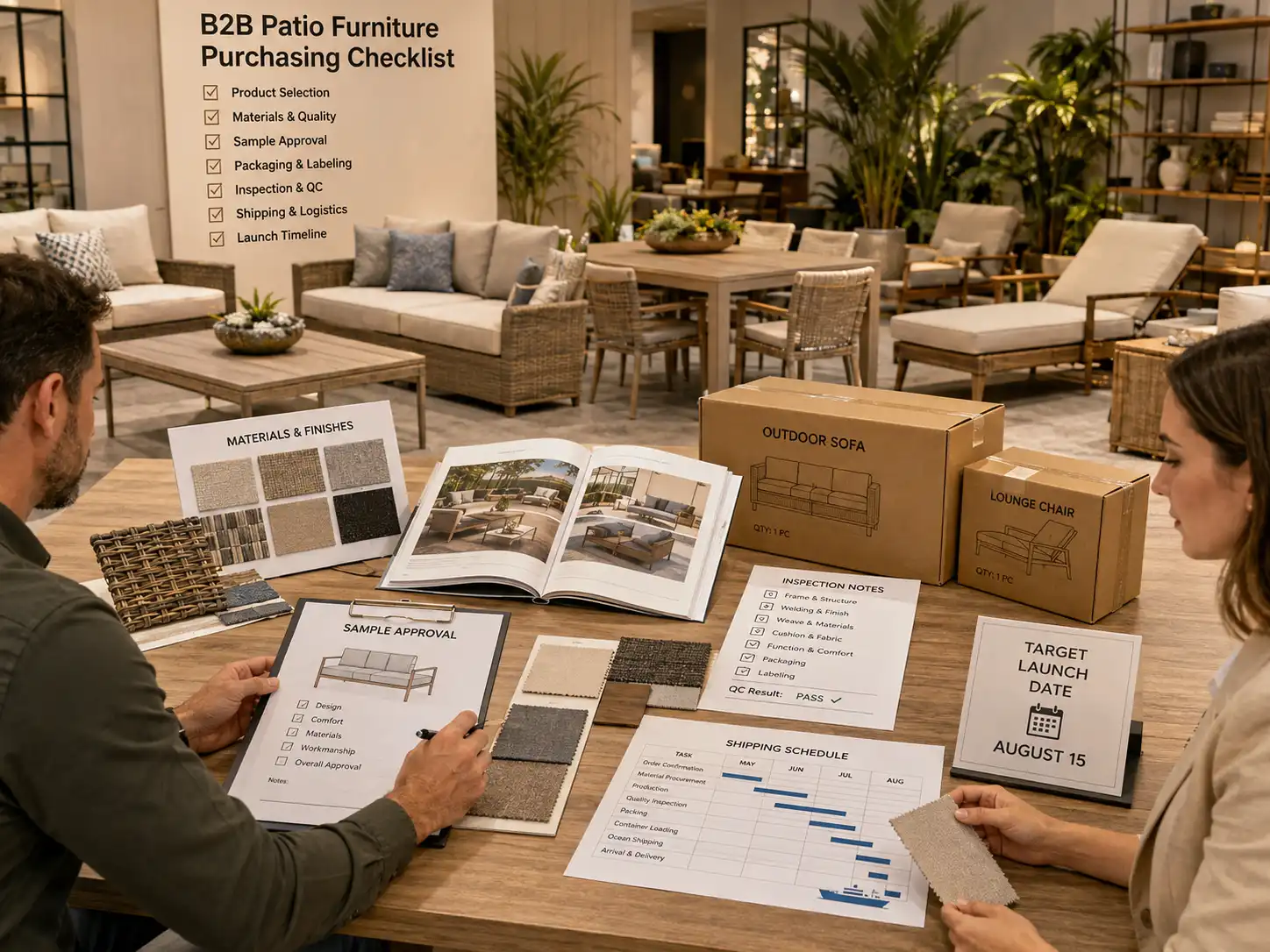
Use this checklist before you approve a Patio Furniture order. It turns the buying window into an operational plan.
| Checkpoint | What to Confirm |
|---|---|
| Range plan | Product categories, key SKUs, colors, accessories, and target retail or project use |
| Market fit | Destination, climate, language, labels, and required product documents |
| Product data | Dimensions, materials, construction, assembly method, care information, and current technical records |
| Packaging | Carton dimensions, KD format, labels, instructions, e-commerce needs, and spare-parts approach |
| Quality review | Sample approval, inspection points, photo standard, and acceptance criteria |
| Commercial plan | Quantity, target launch date, trade term, shipment method, and payment terms confirmed for the order |
The checklist also helps you decide when to buy. A buyer with a complete range plan and confirmed specifications can move into quotation and sample approval. A buyer with an unfinished product brief should stay in the planning stage, even when a promotional window appears attractive.
Turn a Buying Window Into a Supply Plan
The best time to buy Patio Furniture is the period that gives you enough control over the product range and delivery plan. Use confirmed stock for a defined, time-sensitive need. Start earlier when you need a coordinated collection, custom details, or destination-specific documentation. The buying window should support the sales season you are trying to serve.
Joye Leisure, operated by Joye Industrial and Trading (Hangzhou) Co Ltd, supplies outdoor seating, tables, PE wicker products, open-frame furniture, sunshade products, outdoor kitchens, storage, and related accessories. The company also states that it supports OEM and ODM work, packaging planning, finished-product inspection, and service and backup. Use the contact form for a product-specific discussion after you prepare your category list, quantities, destination, packing requirements, target sales season, and document requirements.
FAQ
Q1: When is the best time to buy Patio Furniture for lower prices?
A: A late-season order can suit buyers who can choose from confirmed remaining stock. The key check is whether the available SKUs, colors, accessories, and quantities still fit your range plan.
Q2: When should a wholesale buyer place a Patio Furniture order for a new season?
A: Begin before peak seasonal demand when you need a full assortment or a coordinated collection. Use the extra planning time for samples, product data, packaging, inspection requirements, and shipping arrangements.
Q3: Is late-season Patio Furniture suitable for a private-label program?
A: It can suit a program that uses available products and limited changes. A project with new materials, branding, packaging, or product development needs an earlier approval schedule.
Q4: Which Patio Furniture details should be confirmed before an international order?
A: Confirm the product code, materials, dimensions, packing, assembly method, destination documents, inspection standard, delivery window, and trade term. Product-specific compliance and performance claims need current evidence for the selected market.
Q5: Can Patio Furniture be packed in KD form for e-commerce or container planning?
A: KD packing can support freight and carton planning when the product is designed for it. Confirm the assembly process, carton dimensions, instructions, hardware, labeling, and spare-parts plan for the exact SKU.